Race Registration CLOSES Friday, September 4 at noon!
Your race bibs and bike plaques will be heading to the chipper very soon! While we wait for the bib and bike plaque lists to be published, we thought we’d share some advice on how to pace yourself on our challenging Vermont 50 course.
A few of our race committee members were out on the course last weekend. They were checking for downed trees, overgrown trails, and other changes—but they were also putting themselves through the course to assess the BEST way for you to make it to the finish line on Sunday, September 27th!
The Vermont 50 is a challenging course, and knowing what lies ahead can make a BIG difference on race day. So, before you lace up your running shoes or hop on your bike, take a few minutes to read our Know Before You Go: Pacing the Vermont 50 advice.
A little planning, smart pacing, and knowing where the tough sections are can help you have a much more successful—and enjoyable—day out on the course!
Stay tuned for more race information, and we’ll see you at the Vermont 50!
KNOW BEFORE YOU GO: PLAN YOUR VERMONT 50 PACE!
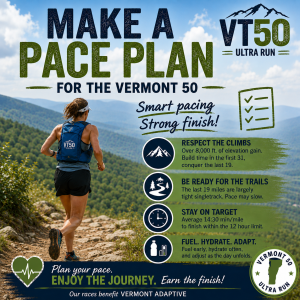
The Vermont 50 is more than 50 miles—it’s 50 miles of elevation, technical terrain, and changing trail conditions. If you’re running the 50-mile race, your pacing strategy can make a big difference in whether you reach the finish by the 6:30 PM course closing time.
You do NOT need to maintain exactly 14:24 minutes per mile throughout the entire race. In fact, that’s not a realistic expectation given the terrain.
The course has more than 8,000 feet of elevation gain, with the first major climb coming just one mile into the race. Long climbs continue throughout the course, with shorter, steeper climbs in between.
For the first 31 miles, the course is primarily packed gravel/dirt roads and doubletrack, with some singletrack mixed in. After mile 31, things change.
The final 19 miles are largely on tight, technical singletrack. You’ll already have 31 miles in your legs, and your pace will likely slow considerably. Faster runners may also encounter mountain bikers sharing the trail.
If you’re close to the cutoff at mile 31, don’t expect to maintain a 14:24-minute pace all the way to the finish.
A very rough guideline is to target approximately a 13:00–13:30-minute-per-mile pace through mile 31.
That gives you some valuable time in the bank:
13:30/mile to Mile 31
→ Save approximately 28 minutes
→ Leaves roughly 15:52/mile for the final 19 miles
13:00/mile to Mile 31
→ Save approximately 43 minutes
→ Leaves roughly 16:41/mile for the final 19 miles
The faster you can comfortably cover those first 31 miles, the more flexibility you’ll have to slow down, hike the climbs, negotiate the technical sections, and still make it to the finish.
Don’t wait until Mile 31 to start thinking about your time.
Have a pacing plan before race day. Know your target times, understand where the course gets tougher, and remember that the final 19 miles are a very different experience from the first 31.
Pace smart. Respect the terrain. Save something for the finish!
And most importantly—enjoy the Vermont 50!
We wish all of our runners and mountain bikers the very best of luck. We can’t wait to see you at the finish line!
See you on the trails!
Zeke Zucker
8-Time Vermont 50 Finisher
DOWLOAD A COPY OF THIS PLAN